The Mirage of the Self-Made Success
The modern personal development industry operates on a seductive, high-gloss promise: that happiness, wealth, and success are merely a “mindset shift” away. We are told that if we simply wake up earlier, manifest with more intensity, and optimize our morning routines, the world will obligingly bend to our will. This narrative transforms success into a purely individualistic pursuit, suggesting that the only thing standing between a person and a luxury villa is their own psychological insufficiency.
However, this relentless focus on individual willpower acts as a high-gloss lacquer over the rot of structural decay. It masks a profound contradiction: if the tools for personal transcendence are more accessible than ever, why is global inequality reaching historic, destabilizing highs? We must confront the possibility that “personal development” is not a ladder for the many, but a manufactured distraction—a psychological buffer designed to keep us from questioning the systemic machinery that harvests wealth while selling us the illusion of limitless potential.
The Burden of Responsibility: You vs. The System
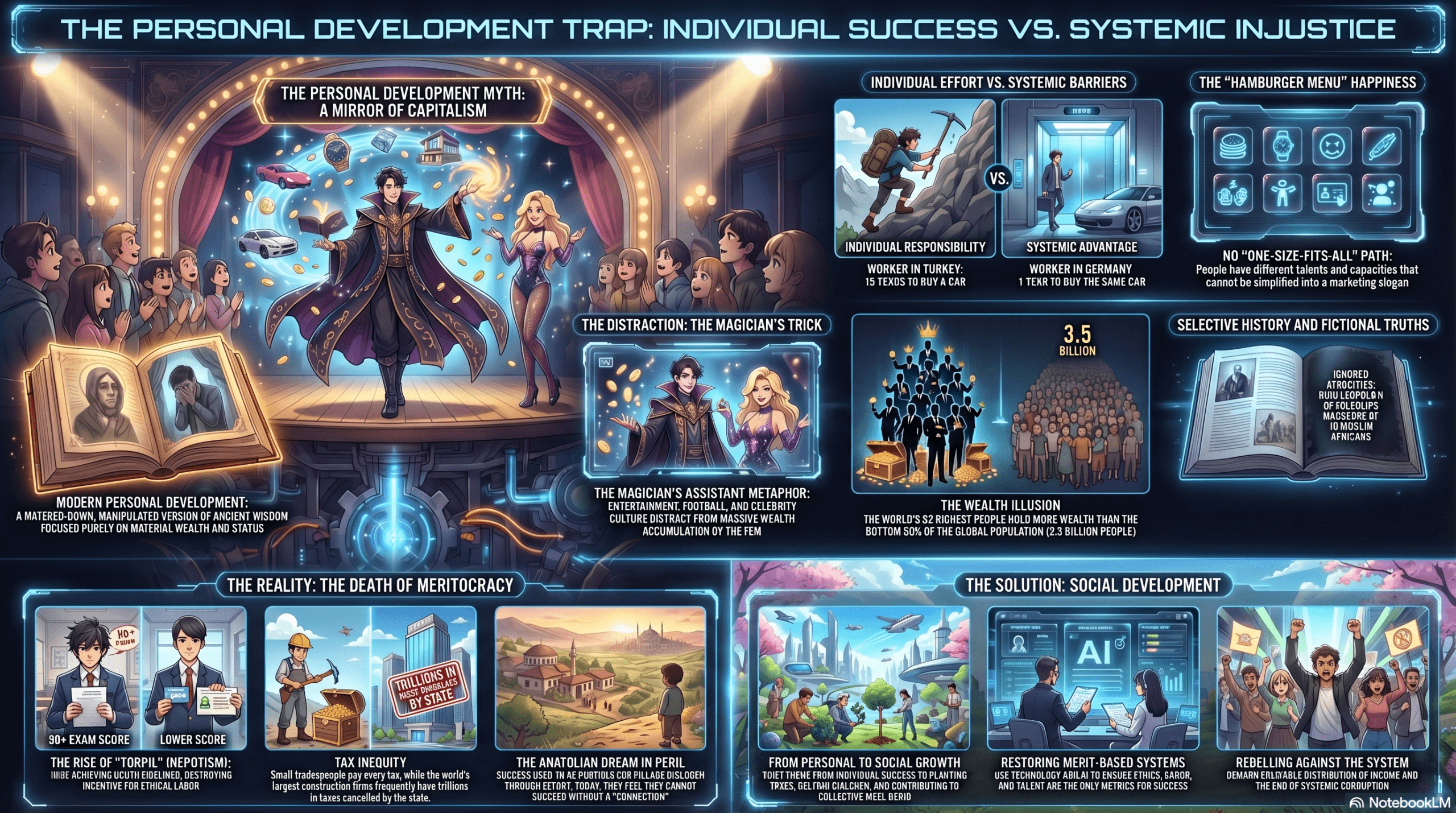
Modern personal development is the ultimate psychological extension of capitalism. By preaching that every failure is the byproduct of a personal shortcoming, the industry shifts the entire burden of accountability onto the individual, leaving the system itself entirely insulated from criticism. This is more than just advice; it is a mechanism for “commodified self-actualization” that ensures the system remains unaccountable. When a highly educated engineer finds themselves driving a truck for a logistics firm, the “hustle culture” narrative suggests they simply haven’t “networked” correctly, rather than pointing to a rigged economy that devalues labor.
This creates a dangerous modern malaise. In previous generations, there was a foundational belief in the “village-to-success” path—a social contract where a child from a humble background could, through sheer merit and effort, rise to lead. Today, that contract is being shredded. When a child sees that success is reserved for those with “brokers” or “political connections,” the economic and moral foundation of society crumbles into cynicism. Telling someone “you can do it” in a broken system is a predatory way of ensuring they do not rebel when that system inevitably fails them.
“Personal development is a reflection of capitalism. Their system pushes everything onto you and leaves the system completely unaccountable.”
The Statistical Illusion: The 62 People Who Own the World
While self-help gurus preach an “abundance mindset,” the cold reality of global data reveals an extreme landscape of extraction. The “limitless opportunity” narrative is a statistical impossibility given current wealth concentration. This data is systematically ignored by the hustle-culture industry because it exposes the “rigged exam” of modern life.
- The Concentration of Power: A mere 62 individuals now possess as much wealth as the bottom half of the global population—roughly 3.5 billion people.
- The Elite Tier: In major global economies, the wealth of just three individuals can exceed the total assets of the bottom 50% of the entire nation’s citizenry.
- Systemic Erasure: These figures are suppressed in motivational circles to maintain the fiction that merit is the sole determinant of wealth accumulation, while ignoring the structural rules that allowed such a grotesque imbalance to occur in the first place.
The Magician’s Assistant: Entertainment as a Distraction
To maintain this level of inequality without sparking a global outcry, the system employs a tactic familiar to any stage magician. A magician uses a glamorous assistant as a “distraction in a miniskirt” to pull the audience’s gaze away from the hand performing the trick. In our world, manufactured apathy is curated through media spectacles, tribalistic sports rivalries, and digital noise.
We are encouraged to spend our emotional capital arguing over referee decisions, social media “cancellations,” or the latest television plot twists. While we are fixated on these trivialities, the “magicians” of the economic system are busy securing 30 separate tax breaks for mega-corporations and construction giants, while the small-business owner—the backbone of the community—is squeezed for every cent. By keeping our attention on the superficial, the system ensures that the monopolization of natural resources and public tenders remains unexamined.
The Selective Lens: Why We Forget 10 Million Lives
The stories we consume shape our sense of justice, but this lens is curated with surgical precision. We are taught to mourn certain victims while others are erased from history because their suffering doesn’t serve the dominant economic narrative.
Consider the comparison of historical atrocities: one event involving the slaughter of 6 million people is documented in hundreds of films and books, becoming a pillar of our collective conscience. Yet another atrocity involving the exploitation of a colony and the death of 10 million people remains virtually unknown to the general public. There are no blockbusters for these 10 million. As the logic goes: “If they sell the idea, they make you believe it is the truth.” By curating which tragedies are “marketable,” the media prevents us from recognizing the long, continuous history of systemic exploitation that underpins our modern “personal development” era.
From Personal Success to Collective Growth
True growth cannot be found in a “hamburger menu” of generic, commodified advice sold to everyone regardless of their unique environment or capacity. Most self-help literature is fundamentally hollow because it strips the individual of their context and community. It focuses obsessively on the brand of your watch or the prestige of your title, while remaining silent on the soul-nourishing work of bettering the world around you.
The most vital elements of human development—contributing to one’s community, environmental stewardship, or mentoring a child—are conspicuously absent from the best-seller lists. This is because these actions foster social development, which is far more threatening to the status quo than an individual’s private pursuit of a better wristwatch.
“There isn’t a single example of adding something to your environment, planting a tree, or holding a child’s hand in those books. They focus only on your watch brand and your wealth.”
The Question of Merit
Effort and merit are essential virtues, but they are fragile; they cannot survive in a vacuum of ethics and accountability. A society where the “exam” is rigged—where merit is discarded in favor of nepotism and political loyalty—is a society in terminal decline. We have the tools to change this; even technology like Artificial Intelligence could be used to grade exams and evaluate potential with total fairness, removing the human bias and “brokers” that currently choke the system. The solution is structural, not just motivational.
We must finally ask ourselves: is our obsession with “personal development” actually a form of compliance? By focusing exclusively on our own optimization, we are neglecting our moral responsibility to demand “social development.” True merit requires an environment of justice to flourish. Until we stop trying to “hustle” our way out of a broken system and start demanding a fair one, we are not developing—we are merely decorating our cages.

Welcome! I'm Hakan (but please, call me Hank).
This isn't just a channel; it's the start of a conversation. I'm a 20+ year educator and tech pro based in New York, and my entire career has been about one thing: sharing knowledge. My professional "journey"—from teaching to tech to my current role at the NYC DOE —taught me that we grow best when we grow together. That's why I built this community. My goal is to share what I've learned and, just as importantly, to learn from you. Let's Connect & Collaborate! I'm always open to new ideas, collaborations, or just making new friends with like-minded learners. This is a space for all of us to share, grow, and build something valuable together. So please, subscribe, join the discussion in the comments, and let's start this journey together.