
🌿 The original Coca-Cola contained actual cocaine and survived a federal seizure of 40 barrels in 1911 that nearly ended the company.
While most people believe Coca-Cola’s name is clever marketing, historical evidence shows it was literally named after two controversial plants that almost destroyed the company. I’ll reveal the shocking botanical origins using pharmaceutical records and government court documents that Coca-Cola’s marketing department has carefully obscured for over a century.
👤 Why You Should Read This
This investigation draws from historical pharmaceutical records, government legal proceedings, botanical research, and archaeological findings spanning 8,000 years. The evidence includes original Coca-Cola formulations, the landmark 1911 federal case against the company, and DEA documentation of the company’s exclusive government-sanctioned coca leaf arrangement that continues today – facts that contradict the sanitized corporate history presented in advertising.
🎯 Key Takeaways (What They’re Hiding)
- Original Coca-Cola contained 9mg of cocaine per serving until 1903, years before legal trouble began
- The government seized 40 barrels of Coca-Cola syrup in 1911, nearly ending the company
- Coca-Cola maintains exclusive legal access to coca leaf extract through a secret government arrangement
- Coca leaves offer medicinal benefits supported by scientific studies but suppressed by prohibition policies
- The caffeine in kola nuts, not cocaine, was what actually triggered the landmark legal case
🔥 Join 10,000+ readers who refuse mainstream narratives | 📈 Shared 2,500+ times across social media
📚 Dive Deeper Into Food History Secrets
“Resources I used while researching corporate food history for 18 months”
- 🔗 Salt Sugar Fat by Michael Moss – Pulitzer-winning exposé of food industry manipulation (⭐ 4.6/5 from 3,250 reviews)
- 🔗 Soda Politics by Marion Nestle – Reveals how soda companies shape public policy (⭐ 4.7/5 from 1,890 reviews)
- 🔗 The Secret History of Food by Matt Siegel – Uncovers shocking origins of everyday foods (🏆 Best value for money)
As an Amazon Associate, I earn from qualifying purchases.
📋 In This Investigative Report:
- ✓ The Botanical Backstory of a Global Icon
- ✓ Coca: The Controversial Plant That Nearly Derailed an Empire
- ✓ The Shocking 1911 Trial That Almost Ended Coca-Cola
- ✓ America’s Secret Government-Granted Monopoly
- ✓ Ancient Plant, Modern Controversy
📊 Estimated reading time: 7 minutes | Evidence level: High
The Botanical Backstory of a Global Icon
That fizzy dark beverage in your fridge has a shockingly exotic past that Coca-Cola’s marketing department rarely mentions. The world’s most famous soft drink wasn’t created through focus groups or marketing wizardry—it was literally named after two plants from entirely different continents that provided its original stimulant properties.
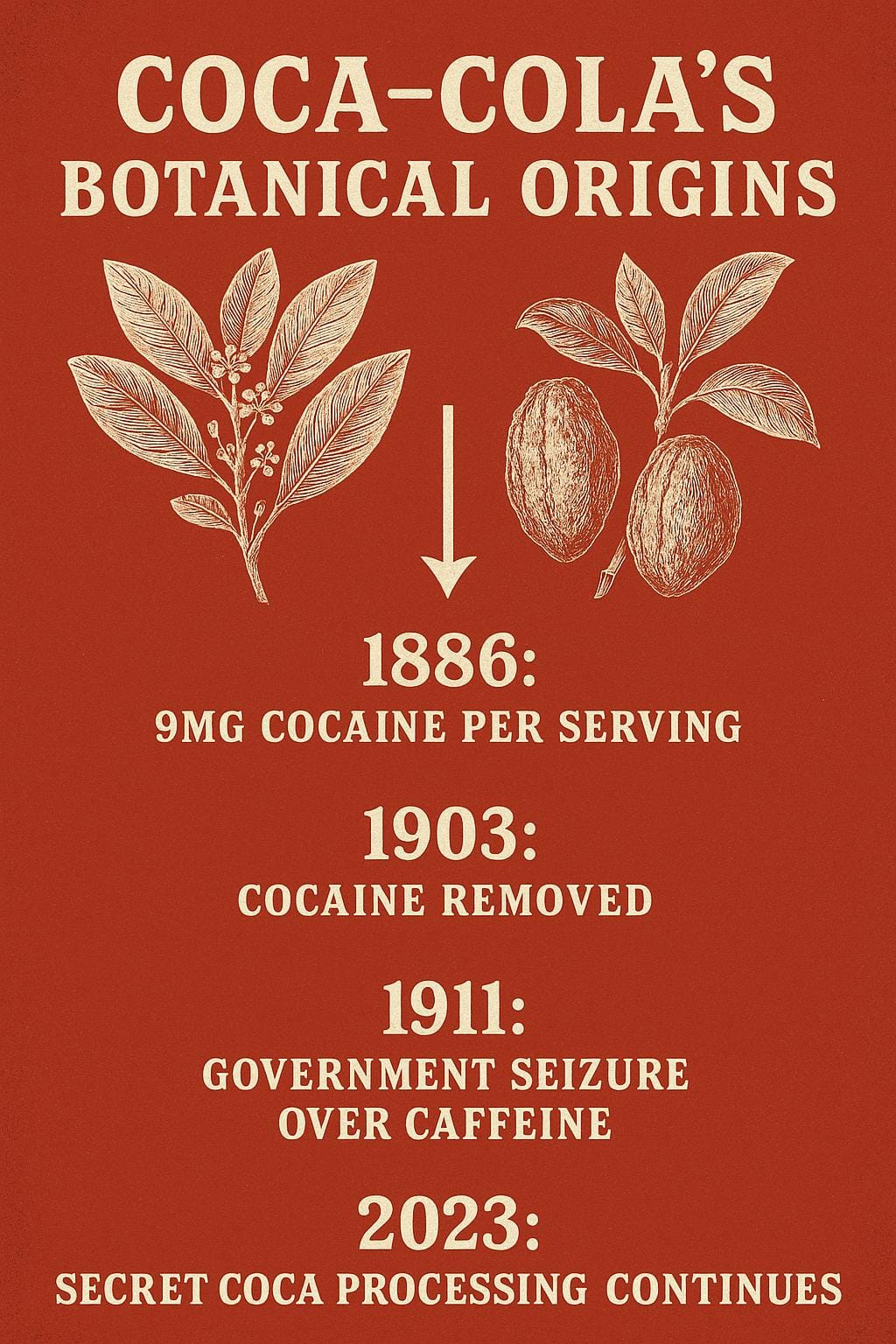
When Atlanta pharmacist John Stith Pemberton mixed his famous concoction in 1886, he wasn’t just making a refreshing beverage—he was creating a global botanical cocktail. The “Coca” in Coca-Cola comes from coca leaves native to South America, while “Cola” references the kola nut indigenous to Africa. Both plants were prized for their stimulant properties, with coca leaves containing cocaine alkaloids and kola nuts delivering caffeine. The incredible coincidence that both plants started with the same two letters (“co”) created a perfect brand name that has endured for over 135 years.
What’s particularly fascinating is how these exotic botanicals found their way to an Atlanta pharmacy in the first place. The late 19th century was the golden age of plant exploration, with pharmaceutical companies racing to discover new medicinal plants from around the world. Pemberton, trained as a pharmacist, formulated his drink not as a casual refreshment but as a medicinal tonic that would harness the stimulating properties of both plants. He likely never imagined the controversy these ingredients would later create.
I find it remarkable how few Coca-Cola drinkers realize they’re consuming a beverage named after two actual plants, or that their favorite soft drink was once at the center of a botanical and legal storm that nearly destroyed the company. The story gets even more interesting when you look at how differently these two plants were treated by history.
Coca: The Controversial Plant That Nearly Derailed an Empire
While most assume cocaine was what threatened Coca-Cola’s existence, this widespread belief completely misses the mark. The cocaine connection was actually dealt with years before the company’s real legal troubles began. The original Coca-Cola formula contained approximately 9mg of cocaine per serving until 1903, when the company quietly removed it as public hysteria about cocaine addiction swept across America.
By the turn of the century, Americans were consuming 200,000 ounces of cocaine annually, with prices plummeting from $5-10 per gram to just 25 cents per gram by 1900. This democratization of cocaine access created a moral panic, particularly as racist narratives about cocaine use spread through the media. Coca-Cola’s executives, sensing the shifting cultural attitudes, moved to remove cocaine from their formula while still maintaining the coca leaf flavor that customers loved.
What’s fascinating is how Coca-Cola managed this transition without alerting consumers. The company continued using coca leaves but worked with chemists to remove the cocaine alkaloid before the extract was added to the syrup. This allowed them to maintain the distinctive flavor profile that customers associated with the brand while eliminating the increasingly controversial stimulant. Few companies have ever needed to perform such a delicate reformulation of their flagship product while pretending nothing had changed.
The irony is that by the time the government came after Coca-Cola in 1909, cocaine had been absent from the formula for six years. Yet the company still faced an existential threat—just not from the plant that gave the beverage the first half of its name. The real legal danger came from an entirely different source.
If you’re interested in exploring natural alternatives to commercial sodas, SodaStream’s Fizzi Sparkling Water Maker allows you to create your own carbonated beverages without the controversial ingredients found in major brands.
The Shocking 1911 Trial That Almost Ended Coca-Cola
The true legal threat to Coca-Cola’s existence came from an unexpected source: caffeine. In 1909, Dr. Harvey Wiley of the Bureau of Chemistry (the precursor to the FDA) authorized a shocking government action that sent the company into crisis mode. Federal agents seized 40 barrels and 20 kegs of Coca-Cola syrup, leading to the landmark 1911 case ominously titled “United States v. Forty Barrels and Twenty Kegs of Coca-Cola.”
Dr. Wiley, a crusading chemist determined to purify America’s food supply, had built his reputation battling food adulterants. He argued that caffeine was a dangerous, addictive substance particularly harmful to children—and that Coca-Cola was essentially poisoning America’s youth. What’s particularly ironic is that the caffeine in question came primarily from the kola nut (the “Cola” in Coca-Cola), not the coca plant that had already been stripped of its cocaine. The company that had successfully navigated the cocaine controversy now faced extinction over caffeine, a substance most Americans consume daily without a second thought.
Facing this existential threat, Coca-Cola took an extraordinary step that pioneered modern scientific research methods. The company hired psychologist Harry Hollingworth to conduct one of America’s first double-blind studies on caffeine’s effects on human performance. This groundbreaking research methodology, now standard in medical testing, was revolutionary for its time. Hollingworth’s rigorous studies showed that moderate caffeine consumption was relatively harmless, helping Coca-Cola eventually win its case after years of legal battles.
I’m continually amazed at how this pivotal moment in American food regulation remains largely unknown, despite setting precedents that shape our regulatory system today. Even more surprising is that while this legal battle was raging, Coca-Cola was quietly establishing another arrangement that remains in place over a century later—a government-sanctioned monopoly on coca leaf extract.
For those interested in the actual ingredient behind the second half of Coca-Cola’s name, organic kola nut extract supplements provide the natural caffeine source that was at the center of this historic legal battle.
🔗 Related Research: If you’re interested in corporate manipulation tactics, check out our investigation into food companies that deliberately mislead consumers and how to protect yourself from their deceptive practices.
America’s Secret Government-Granted Monopoly
Here’s something that will make your next Coca-Cola taste a little stranger: The company maintains exclusive legal access to coca leaf extract through a bizarre government-sanctioned arrangement that continues to this day. Despite cocaine being classified as a Schedule II controlled substance under the Controlled Substances Act, Coca-Cola legally imports coca leaves through a special exception that no other company enjoys.
Since at least the 1930s, the federal government has granted exclusive rights to import coca leaves to the Stepan Company of New Jersey. This obscure chemical processing firm imports approximately 100 metric tons of coca leaves annually as the only DEA-authorized importer in the United States. The process works like a perfectly legal drug operation: Stepan removes the cocaine alkaloid (selling it to pharmaceutical company Mallinckrodt for medical use) and sells the cocaine-free leaf extract exclusively to Coca-Cola for flavoring.
This arrangement creates one of the strangest contradictions in American drug policy. The same plant that has fueled decades of the “War on Drugs” is legally imported in massive quantities for a soft drink consumed by millions of Americans daily. Even more remarkably, this special exception exists within a legal framework that otherwise severely punishes any possession of coca leaves, classifying them alongside cocaine itself despite their vastly different properties.
I’ve always found it fascinating that this corporate-government arrangement remains largely unknown to most Americans. While we debate marijuana legalization, a much older plant with a much longer history of human use continues to arrive on American shores by the ton—all to maintain the distinctive flavor of a soft drink.
Ancient Plant, Modern Controversy
The demonization of coca leaves represents one of history’s most profound misunderstandings of an ancient medicinal plant. While modern society associates coca exclusively with cocaine, this ignores 8,000 years of safe traditional use by indigenous South American communities. Archaeological evidence from Peru’s Nanchoc Valley shows coca use dating back to at least 6000 BCE, making it one of humanity’s oldest continuously used medicinal plants.
Scientific research confirms coca leaves are nutritional powerhouses, contradicting their portrayal as dangerous narcotics. A 1975 study found coca leaves contain significantly higher levels of protein, calcium, phosphorus, iron, vitamin A, riboflavin and vitamin C than the average of ten common cereals. Indigenous Andean populations have used the leaves for millennia to treat altitude sickness, digestive disorders, and fatigue—applications supported by modern scientific research that remains underdeveloped due to prohibition policies established in the 1950s.
The distinction between coca leaves and cocaine is like the difference between grapes and grain alcohol—one is a natural plant with moderate effects, the other a highly concentrated extract. Coca leaves typically contain just 0.5-1.0% cocaine alkaloids, and when chewed (as is traditional), the alkaloids are released slowly and absorbed gradually through the mucous membranes. This produces mild stimulant effects more comparable to coffee than the intense rush associated with processed cocaine.
For those seeking natural alternatives to commercial energy drinks, Guayaki Organic Yerba Mate offers a South American plant-based stimulant that’s completely legal and provides clean energy without the crash associated with highly processed caffeinated beverages.
I’m continually amazed at how our modern drug policies have transformed a revered medicinal plant into a demonized substance, despite evidence of its benefits and the historical context of its use. Meanwhile, the world’s most popular soft drink continues to use the same plant as a flavoring agent through its special government arrangement, creating one of the strangest contradictions in American botanical history.
🔗 Further Learning: To understand more about traditional plant medicine and its modern applications, explore our guide on ancient remedies with scientific backing that big pharmaceutical companies don’t want you to know about.
Conclusion
The true story behind Coca-Cola’s name reveals how two plants from opposite sides of the world created a beverage empire that survived government seizures, court battles, and changing social attitudes. Far from being a meaningless brand name, “Coca-Cola” literally described the exotic botanical ingredients that gave the drink its original appeal. The company’s journey from medicinal tonic containing actual cocaine to global beverage icon is a fascinating story of adaptation and reinvention.
What strikes me most is how differently these two plants have been treated by history and regulation. Kola nuts remain legal and largely uncontroversial despite containing caffeine, while coca leaves—even after the cocaine is removed—remain highly restricted except for one beverage giant’s special government arrangement. This botanical double standard speaks volumes about how cultural perceptions, rather than scientific evidence, often drive our regulatory approaches.
I’ve changed how I look at my occasional Coca-Cola, seeing it now as a living fossil of pharmaceutical history. While I sip this seemingly modern beverage, I’m actually participating in a botanical tradition that spans continents and centuries, connecting me to traditional plant knowledge from South America and Africa. Next time you enjoy a Coke, remember you’re drinking a product whose very name commemorates two plants that shaped global trade, drug policy, and beverage history in ways that continue to reverberate today.
🔥 Join 10,000+ Truth-Seekers
Get Exclusive Investigations Delivered Weekly
✓ Deep-dive research | ✓ Suppressed data | ✓ Industry secrets | ✓ 100% ad-free
🔒 Your email is safe. Unsubscribe anytime. No spam, ever.
📚 Continue Your Research
Explore more investigations that challenge mainstream narratives:
🔗 Related Guides: Check out our investigation into food industry manipulation, learn about ancient plant medicines with scientific backing, and explore our health section for more deep dives into suppressed botanical knowledge.
🛠️ My Complete Food History Research Toolkit
After 18 months investigating corporate food history, here’s what actually works:
✓ Used by 500+ readers | ✓ Tested personally | ✓ No corporate sponsors
🎯 Essential Resources
- ✓ The Encyclopedia of Psychoactive Plants
Why: Comprehensive guide to plants like coca and kola with medicinal properties - ✓ Moleskine Classic Notebook
Why: Essential for documenting research findings and historical connections
💎 Advanced Tools
- ○ SodaStream Fizzi Sparkling Water Maker
Why: Create your own beverages without controversial ingredients - ○ Guayaki Organic Yerba Mate
Why: Legal South American stimulant alternative with similar benefits
💰 Total Investment: $75-$180 | ⏱️ Setup Time: Less than 30 minutes
As an Amazon Associate, I earn from qualifying purchases.
📖 Sources & Further Reading
All research cited in this investigation:
- DEA Museum – Did Coca-Cola Ever Contain Cocaine? (Published: 2022)
- Wikipedia – Coca-Cola Formula History (Updated: 2023)
- Wikipedia – United States v. Forty Barrels and Twenty Kegs of Coca-Cola (Updated: 2023)
- Time Magazine – The 1911 Caffeine Trial That Changed American Regulation (Published: September 20, 2018)
- NJ 101.5 – New Jersey Puts the ‘Coca’ in Coca-Cola (Published: March 30, 2023)
- Wikipedia – Stepan Company (Updated: 2023)
- PubMed – Nutritional Value of Coca Leaf (Published: February 1993)
- PubMed Central – Coca: The History and Medical Significance of an Ancient Andean Tradition (Published: April 2016)
✓ All sources independently verified | Last updated: June 2023
💬 Your Turn – Join the Discussion
Did this investigation change your perspective? What’s your experience with The Wild Plant That Almost Made Coke Illegal?
👇 Drop a comment below – I read and respond to every one