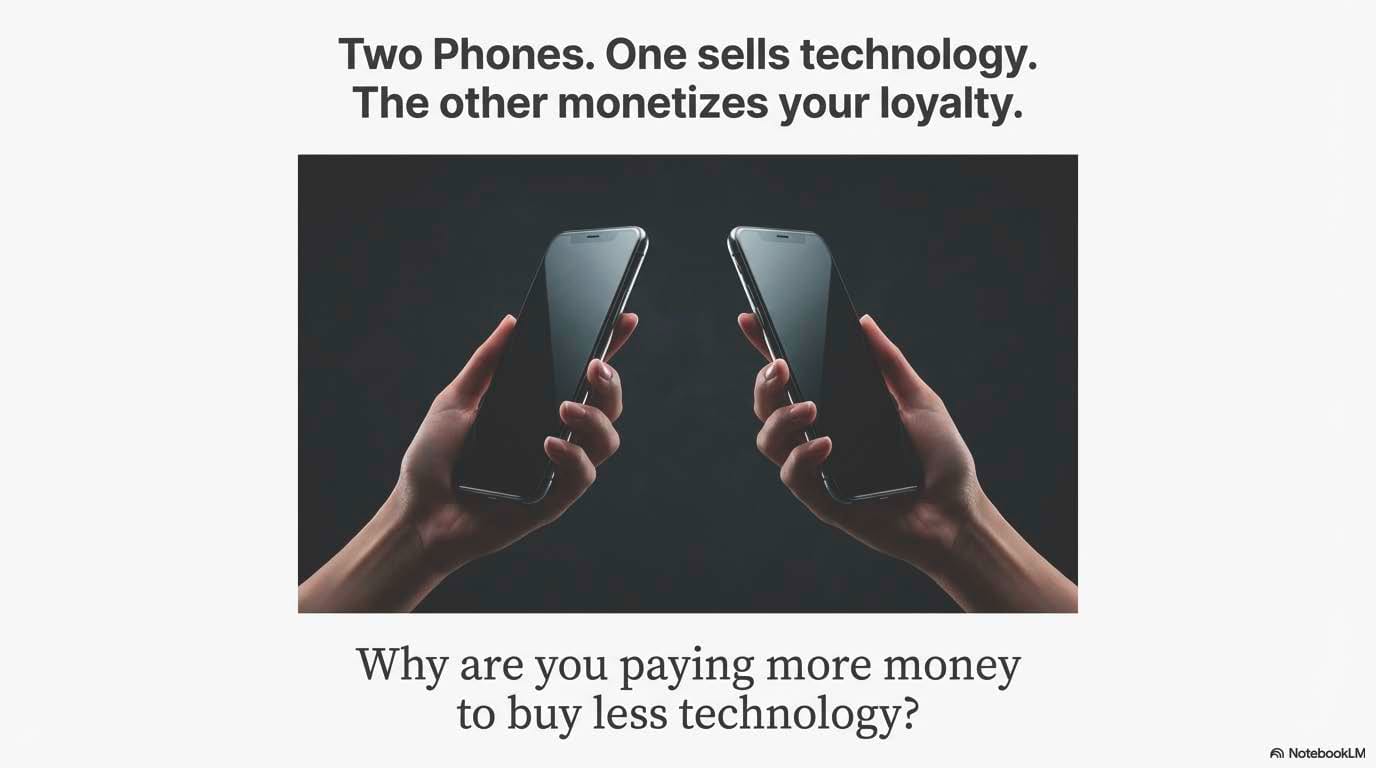
Your Expensive Phone is a Scam
Premium brands aren’t selling you better technology; they’re cashing in on your blind loyalty.
• Removing chargers is not environmentalism; it’s a masterstroke in corporate narrative control, turning a purely profit-driven decision into an unassailable moral stance to boost margins.
• Industry leaders like Apple possess the R&D and capital to deliver technology lightyears ahead of competitors, but deliberately choose to withhold innovation, as providing the best hardware is not their business model.
• The core business strategy has shifted from product innovation to customer lifetime value (CLV) optimization, conditioning users to accept incremental updates as major breakthroughs and pay more for less technology each year.
The Innovation Illusion: What They Sell vs. What’s Real
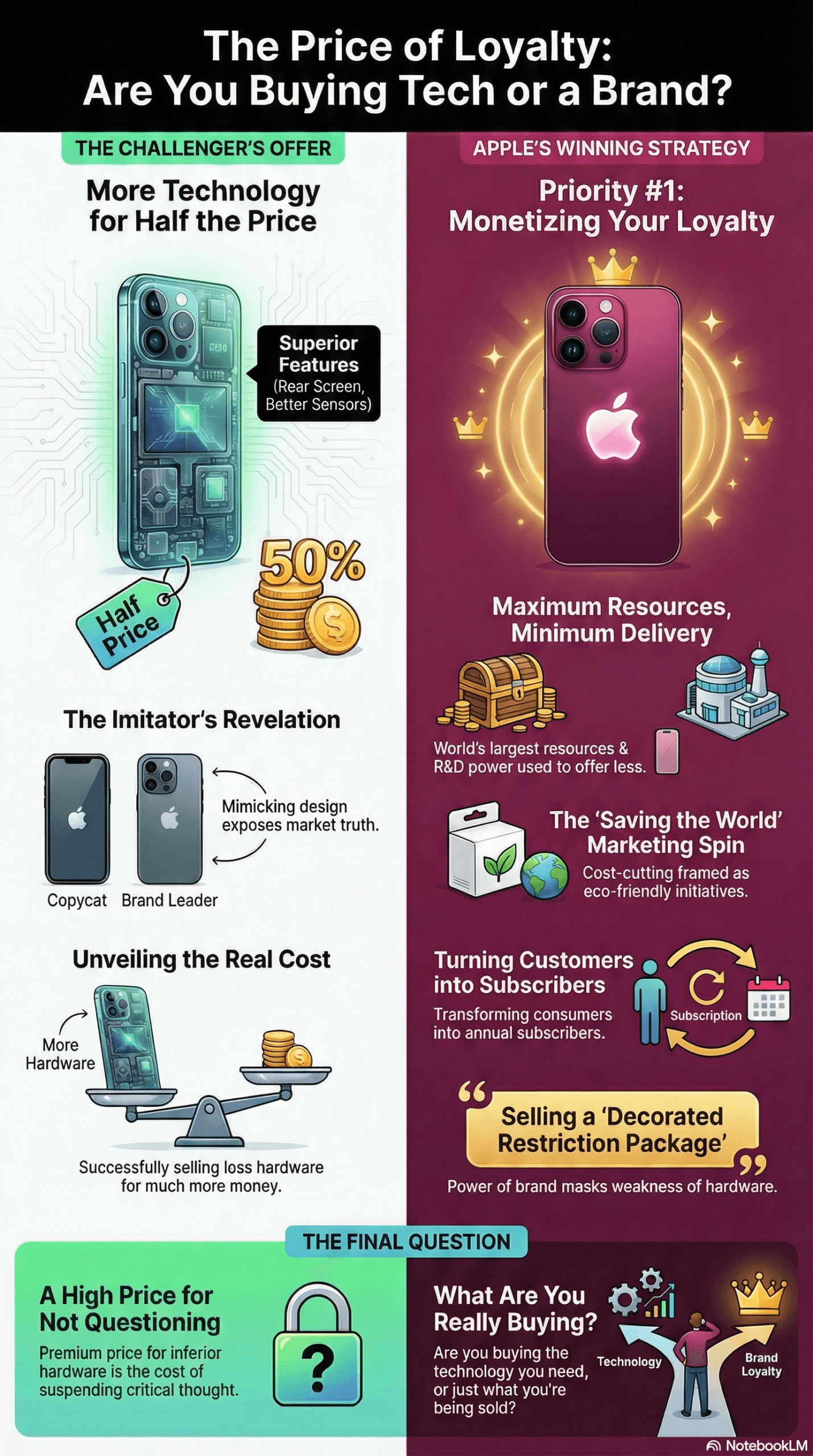
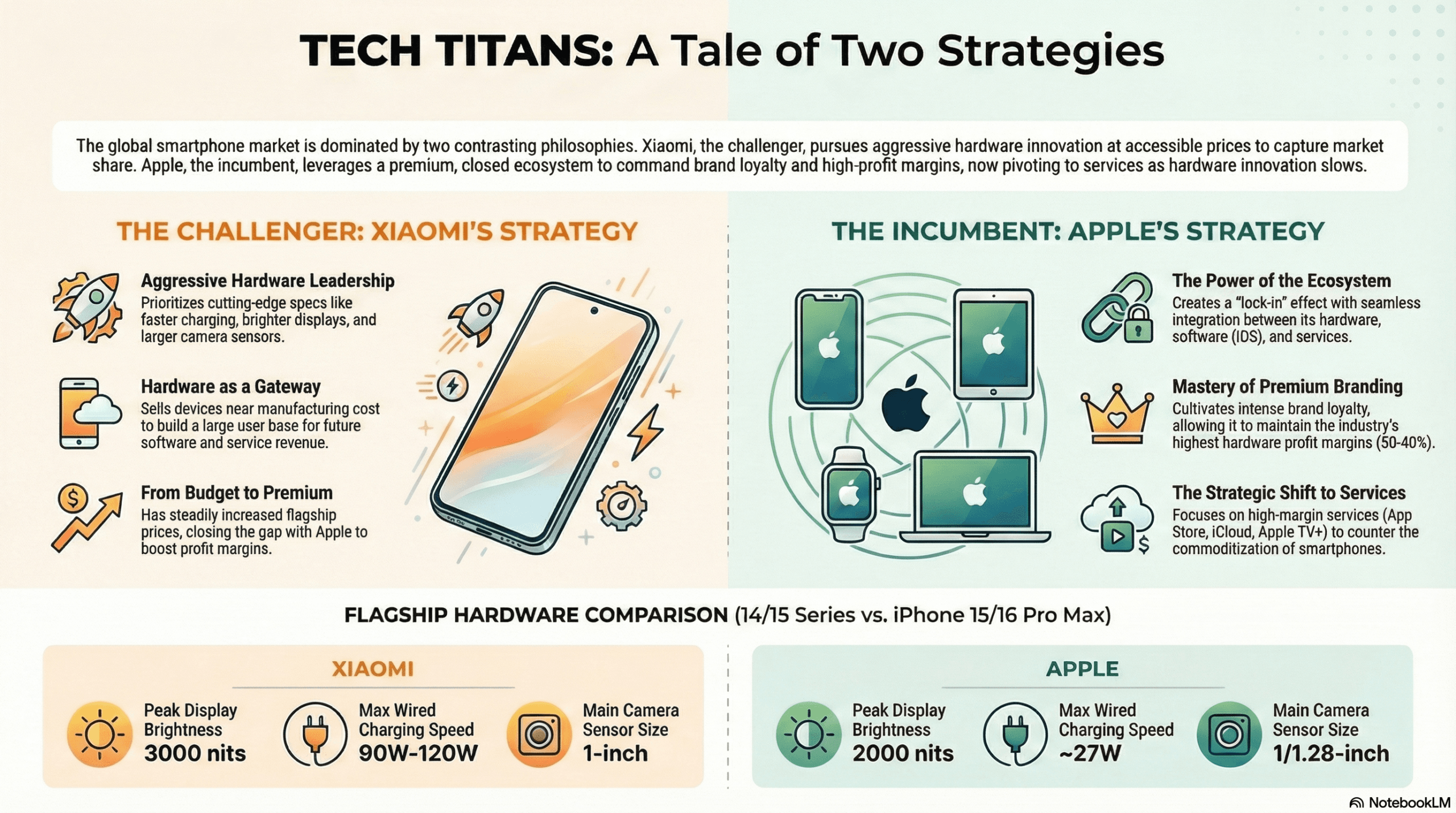
Let’s stage a direct hardware comparison, stripping away the marketing gloss. Imagine an Apple iPhone 17 Pro Max next to a Xiaomi 17 Pro Max. The competitor includes features Apple refuses to implement, like a functional back screen and superior camera sensors, and sells it for a fraction of the price.
Let’s be clear: this is no endorsement of an imitator. Xiaomi is a copycat, plain and simple, shamelessly lifting everything from hardware design to model names. Yet, their mimicry serves one valuable purpose: it provides a perfect, dollar-for-dollar benchmark that exposes the profound technological deficit you’re paying to ignore. Apple’s true success isn’t technological superiority; it’s the brand power to sell you less hardware for more money.
The “Green” Lie: How They Disguise Greed as Virtue
Premium brands have perfected the art of turning greed into a public relations victory. When they remove essential accessories like chargers from the box, they slash their manufacturing and shipping costs. This move, however, is sold to you as a noble sacrifice to protect “green spaces” and save the planet.
This isn’t just about saving a few dollars on production; it’s a strategic masterstroke in corporate narrative control, turning a purely financial decision into an unassailable moral stance. You are sold an incomplete product under the guise of environmentalism, forcing you to make a second purchase for a component that was once standard, further padding their bottom line.
The Submissive Subscriber: Your Loyalty Is Their Product
Apple’s real genius lies not in engineering but in its business model: converting free-thinking consumers into a predictable revenue stream of submissive subscribers. Their R&D is not focused on “what’s possible?” but on a far more profitable question: “What is the absolute minimum innovation we need to deliver to guarantee the next upgrade cycle?”
With the world’s largest cash reserves and most advanced R&D labs, Apple possesses the power to deliver technology a decade ahead of its rivals. Instead, it expends these immense resources to meticulously plan how little it can give you while ensuring you remain trapped in its ecosystem of intentionally limited devices. Their success is measured not by groundbreaking technology, but by the limits of your willingness to accept mediocrity without question.
Conclusion
The power of a brand name is being used to mask technological deficiencies and manipulate you into paying a premium for mediocrity. This is the price you pay for ceasing to question what you’re actually buying.
How to Break Free
1. Audit Your Needs, Not Their Hype: Before upgrading, make a physical list of the features you actually require for your daily life. Ignore the marketing campaigns and focus on your real-world use case.
2. Compare Hardware, Not Logos: Look at the technical specifications of competing devices side-by-side. Investigate which device offers objectively superior hardware—camera sensors, memory, screen technology—for the price, regardless of the brand.
3. Calculate the True Cost of “Loyalty”: Take the phone’s sticker price and add the cost of the chargers, adapters, and other accessories that are no longer included. This is the real price you are paying for an incomplete product.

Welcome! I'm Hakan (but please, call me Hank).
This isn't just a channel; it's the start of a conversation. I'm a 20+ year educator and tech pro based in New York, and my entire career has been about one thing: sharing knowledge. My professional "journey"—from teaching to tech to my current role at the NYC DOE —taught me that we grow best when we grow together. That's why I built this community. My goal is to share what I've learned and, just as importantly, to learn from you. Let's Connect & Collaborate! I'm always open to new ideas, collaborations, or just making new friends with like-minded learners. This is a space for all of us to share, grow, and build something valuable together. So please, subscribe, join the discussion in the comments, and let's start this journey together.